
At enterprise concurrency, distributing and operating build execution across a cluster is no longer a performance trick. It is the execution layer of Build Management at AI Scale.
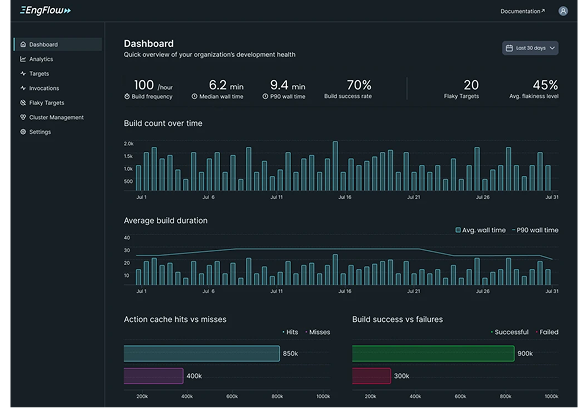
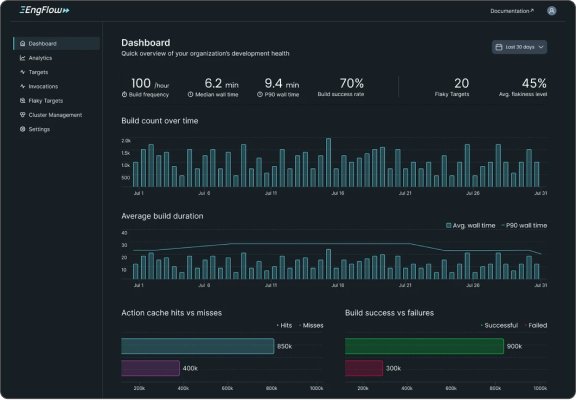
As organizations scale, simple local builds turn into a systemic bottleneck:
→ Build times that block flow and force context switching
→ Resource contention across developers and CI jobs
→ Flakiness and unpredictability when under sustained load
→ Cost volatility as build volume grows
These are symptoms of unmanaged build infrastructure—not just “slow builds.” Remote Execution distributes work across a cluster, removing saturation points and grounding build as an operational service, not an ad hoc process. (docs.engflow.com)
Instead of running on a developer machine or a single runner, build actions execute on a pool of shared machines—reducing individual job duration and improving predictability. (docs.engflow.com)
Results of remote executions are cached, eliminating redundant work and accelerating incremental loops across teams. (engflow.com)
EngFlow Remote Execution works with any client that implements the Remote Execution API—including Bazel, Buck2, CMake (via CMake RE), Goma Server and Reclient (Chromium), Pants, Please, Recc, BuildStream, and Soong (AOSP).—so you can scale without disruptive rewrites. (engflow.com)
Clusters adjust capacity based on load, smoothing peak demand, and recovering efficiency off-peak—reducing both wait times and cloud spend. (engflow.com)
Remote Execution delivers measurable impact when integrated into a managed build platform:
Separates infrastructure capacity from individual machine constraints.
By maximizing utilization across shared clusters and caching results, teams reduce compute waste. (EngFlow Blog)
EngFlow Remote Execution adapts to your operational requirements:


Supported platforms include AWS, Azure, GCP, Kubernetes, MacStadium, OpenStack, and more.
Across its managed fleet, EngFlow runs 3.5 billion build and test actions every week on clusters that scale from one core to more than 100,000.
Remote Execution is the execution layer of Build Management at AI Scale.